Most of us only do a partial audit of our lives.
We check the areas we feel good about.
We avoid the ones that feel stuck.
Slowly, the gap between where we are and where we actually want to be grows.
That’s the Invisible Drift – the kind that only becomes visible when you stop and look at the full picture.
The person whose career no longer feels like their own path but who’s high-functioning enough that it doesn’t feel urgent to address.
The relationship that works on the surface, but where something has shifted and no one wants to bring it up.
The physical health that’s been quietly deprioritised for so long that it stopped feeling like a choice and started feeling like just how things are.
The person who, by any external measure, is thriving but who wakes up anxious most mornings without fully knowing why.
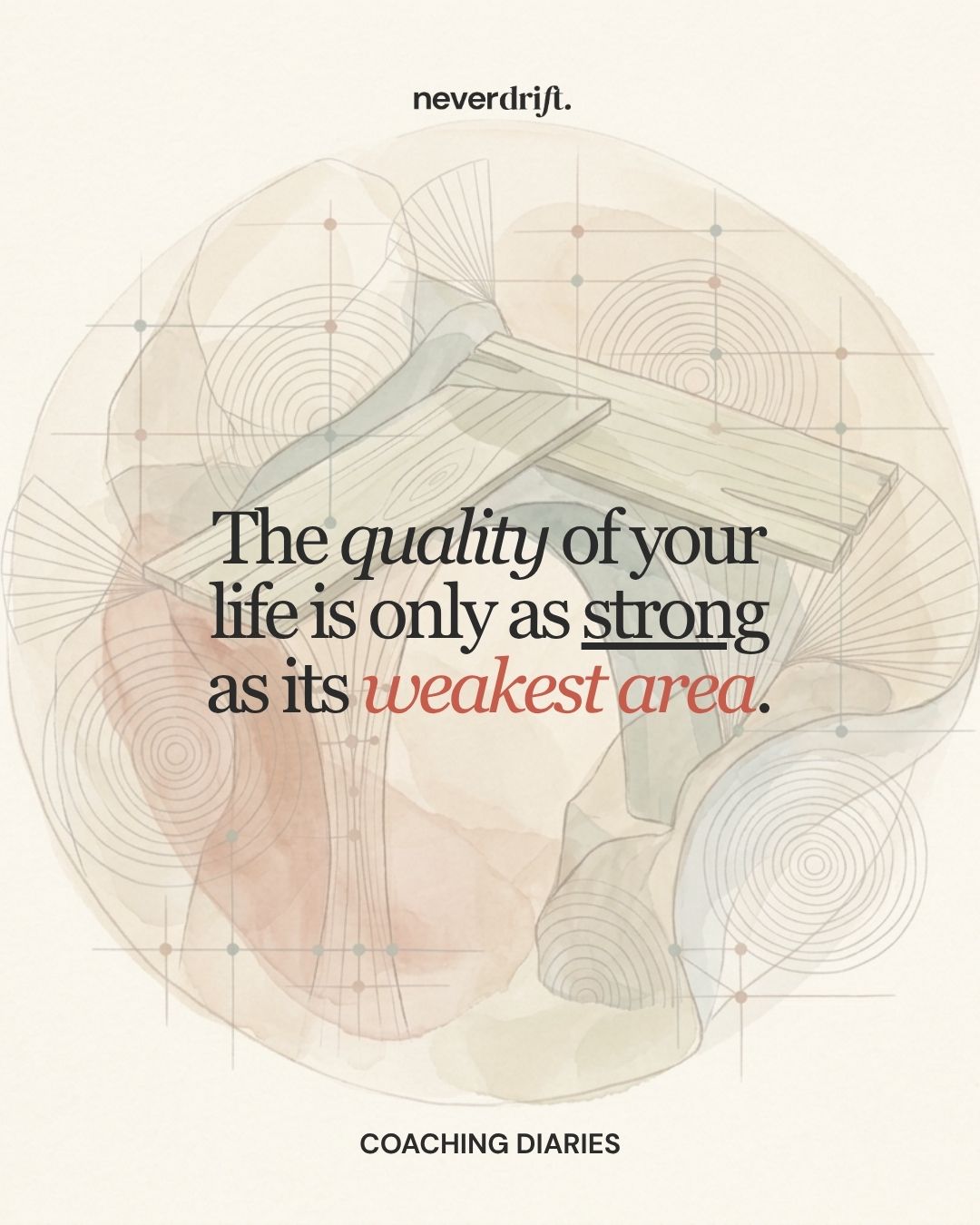
All these carry weight and the costs compounds when not addressed.
I think about this often when people ask why I coach holistically rather than specialise in one area like relationships or career.
To me, the same patterns tend to show up in different areas of our lives.
A person who struggles to set boundaries at work tends to struggle with it in their closest relationships too.
A person who has difficulty discerning what is enough would also tend to burn themselves out in work and fitness.
It is the same operating system that powers our different areas of life.
This is why I work at the root cause rather than the symptom.
Coaching with me almost always starts in one domain — usually career, because that’s where most people feel the urgency first.
It takes up the most time, produces the most visible results, and is the easiest to point to when something feels off.
But what clients consistently find, once we map the full picture, is that the pattern they came in with isn’t contained to their career.
We work on what’s most pressing AND what we learn also transfers to the other domains of life.
The areas where we’re struggling are rarely asking for a complete overhaul.
Most of the time, what’s needed is simpler and harder at the same time.
The honesty to see what’s actually happening
The willingness to want something different
The tolerance to sit with discomfort long enough to do something about it.
These aren’t merely relationship skills or career skills. They are life skills that compound across everything.
🍀If something in this post made you pause, that’s usually worth looking at. Learn more about working with Natalie here.