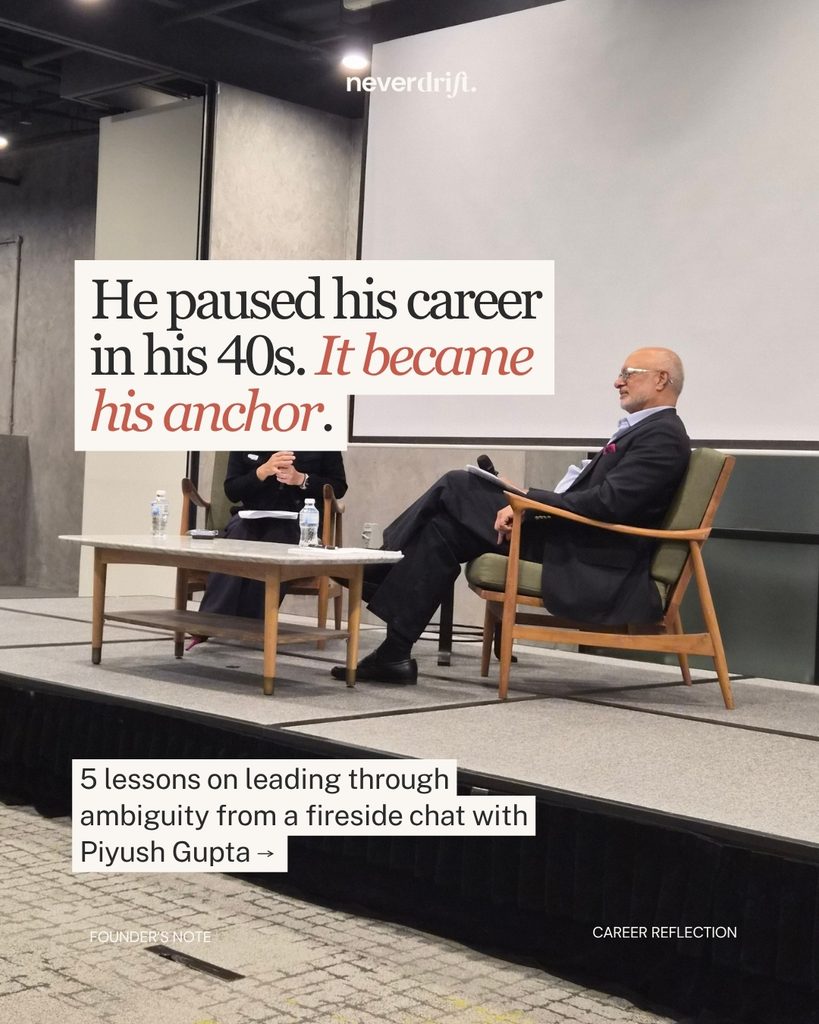
I attended a fireside chat on Leading Through Complexity & Ambiguity with Piyush Gupta who was the former CEO of DBS Bank.
He has always been a leader that is looked up to by many. I learnt so much from the talk including the fact that he actually held 22 different roles at Citibank.
Sharing the lessons that stayed with me.
1. Purpose is the anchor when your trajectory seems uncertain
In his 40s, Piyush took a pause from banking to join a tech start-up. When he decided to return to banking, it looked like a step backwards: a job he could have been doing years earlier.
But what he realised was given the lessons he learnt in the start-up, when he returned, he came back with the conviction that he can actually be far better at banking.
And that made him a better leader.
Your trajectory can change. What anchors you doesn’t have to.
2. What’s worth doing starts with the belief that it can be done
When asked about what his “failures” were, he shared how an earlier $500M transformation at DBS had not worked out as planned.
Then a 2012 meeting with Jack Ma at Ant Financial changed how he saw the bank of the future and he went to the board with his big bet.
His sequence: 1) Believe it can be done. 2) Ask if it’s worth the effort. 3) Then go all in.
Conviction gets you started. Viability and conviction keep you going.
3. Failure changes your relationship with risk
Once he’d seen the bottom of the barrel during his start-up days, nothing else could faze him.
In the US, he pointed out that founders who’ve failed three times are actually more likely to get funding. This point also seems connected to my earlier posts on Eileen Gu and Reese Witherspoon.
The people who move the needle have the tenacity to weather the storm, and they don’t compromise.
Surviving failure makes you braver about the next risk and also reframes your perspective.
4. Develop a point of view, but don’t make it rigid
Take time out to form a view on things. He shared he reads from many different disciplines.
Then he listens and observes a lot, so you can modify that view rather than defend it.
He shared how range helps too. Trying out 22 roles at Citibank gave him a wide variety of experience to draw on. When asked about his perspective on education going forward as the new Chairman of the Board of Trustees at Singapore Management University, he said: Ten minors beat one major.
Good judgement is a strong view you keep testing.
Develop a point of view, then listen enough to change it.
5. In the age of AI, keep the thinking yours
Piyush talked about cognitive debt: the more thinking we hand to AI, the more mental muscle we lose, the way memory weakens when we stop using it.
His answer to AI: judgement, and eclectic knowledge that lets you connect the dots.
That comes from curiosity, the Socratic method and unfamiliar situations. There’s no replacement for getting your hands dirty.
He also meditates and has broad interests to quiet his mind and find balance amidst everything. That also shows me the importance of cultivating mental hygiene.
What I keep coming back to
The part I keep coming back to is how deliberately he protects his thinking. Brain on in the office, off at home. Meditation every morning and evening since the dotcom crash. For someone whose judgement shaped a bank, rest wasn’t a reward. It was part of the work.
Leading through ambiguity
It takes conviction to commit before the answers are clear.
Curiosity to keep reading, questioning and adapting as you go.
And the judgement to know when to persevere, when to pivot and when to let go.
What’s one point of view you’ve changed your mind on this year?
If you’re not sure where your own thinking needs more room, the 3-minute reflection quiz is a good place to start. You can also explore 1-1 coaching, or join the newsletter for weekly reflections like this one.