
I first met Vanessa when I was working at Google.
Before I left the company, I led a workshop at our corporate offsite in Bali and something shifted for her in that room.
She came back to it later, when life had slowed down enough for her to actually do something with the realisation.
Timing matters. Vanessa’s story shows what happens when a high-performing woman finally has enough breathing room to look at how she’s been operating and realises the system that got her through was costing her.
Of all the stories in this series, Vanessa’s is perhaps the most recognisable to the high-achiever who always seemed calm to everyone else but was actually feeling anxious on the inside.
The ones who are managing everything, tracking everything, researching everything – and genuinely don’t see it as a sign that something is off. They see it as competence.
That’s the part worth looking at closely.
If you haven’t read the piece on threshold and accumulation moments yet, it’s worth starting there before you continue. Vanessa’s story is one of the clearest examples of an accumulation entry point I’ve seen.
A) Vanessa, in her own words
“If I had to summarise the common outside view, it was a bit of a long marathon marked with extended sprints without a clear compass of what could be happening next. Hence, I was constantly in fight or flight. It was COVID times and I was also navigating a new role and a move back home after almost a decade abroad. Lots going on.
With my second child, I will like to think this compass got clearer and the day to day felt more manageable. I was no longer sprinting all the time. I felt ‘sustainable’ as a feeling and actual state of reality happen more often and I was able to expand my capacity in ways I did not expect – I always thought I’d need to rely on a helper to keep the household going but I’m now a full-time working mum with two kids without help, who has learnt to cook (and cook food that my family will actually eat!) while keeping the other parts of my life going. This is definitely not a vision of myself my 25-year-old self would have expected.
As someone who always prided myself on being productive and a high performer, I felt something needed to change when I was starting to become overtly anxious and in my own head more often than I should.
Outwardly, I poured this energy into sheets tracking my kids’ sick days, what combinations of vitamins and supplements they were taking and spent a lot of time researching on Reddit and parenting forums.
Interestingly, I never did any research or tried to go deeper to understand why I was operating like that – even when someone remarked that I was operating with a lot of intensity. I now know that as an Enneagram 5 and 6, this was my way of gathering knowledge and finding patterns to develop a sense of calm amongst the chaos of parenting and motherhood.
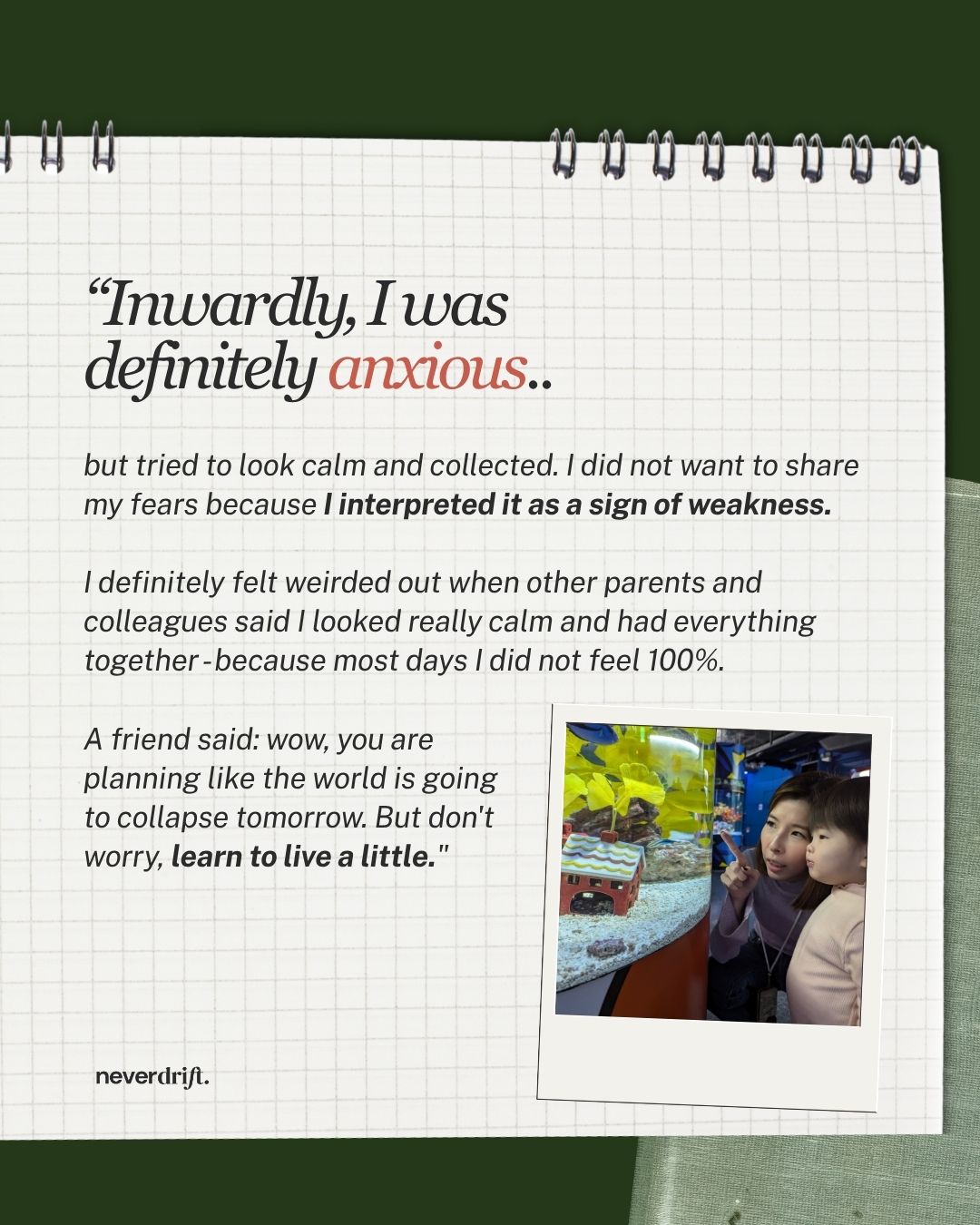
Inwardly, I was definitely anxious but tried to look calm and collected. I did not want to share my fears, worries and speculations because I interpreted it as a sign of weakness.
It did not help that the first major wave of layoffs happened during my second pregnancy, just as I was about to give birth, so that really drove me into an overdrive of worst-case scenario planning.
I definitely felt weirded out when other parents and colleagues said I looked really calm and had everything together, because most days I did not feel 100%.
I remember, distinctly, having a conversation with a friend who already had two grown-up kids – she said, wow you are planning like the world is going to collapse tomorrow, but don’t worry, learn to live a little.
Initially, this shift affected me mentally because I began to regularly wake up in the middle of the night with thoughts racing. Sometimes that meant I had to go sit at my laptop because I thought I could have done something better on the work front, or I had to research more thoroughly on a topic. And I found myself over-preparing for every work-related engagement to the point that it was not productive.
Physically, I also felt that I was falling sick more often, and taking longer to recover each time. This was a clear signal to me that I needed to fix something.
However, over time, this has led me to develop a better understanding of my health patterns and also made me be more intentional regarding things like exercise, making sure I incorporate more movement into my lifestyle, and also to have better sleep hygiene.
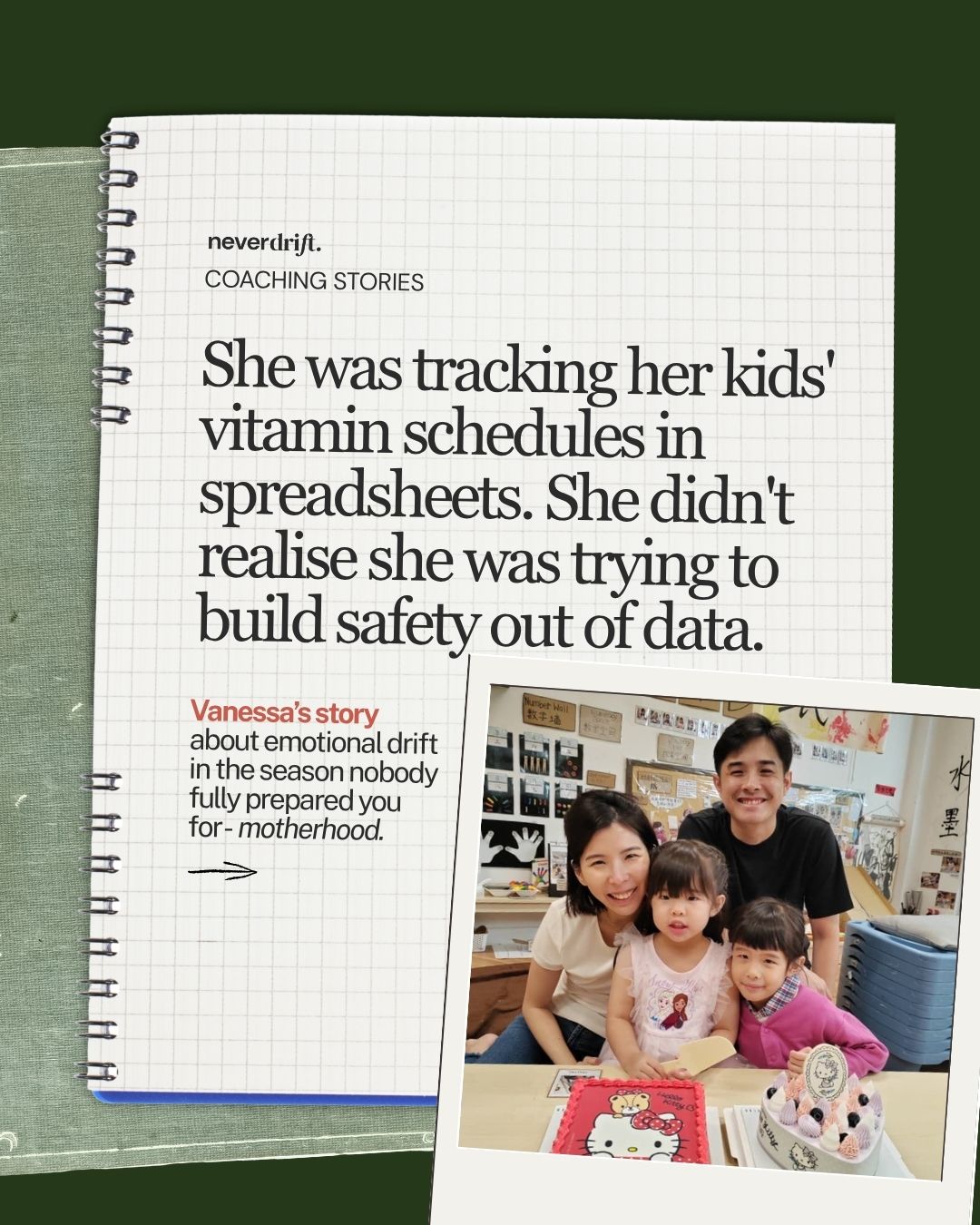
Ironically, when things started to settle down with my kids, home and work, did I realise – wow, ok, now I can really take a breather and do some inner work to help myself. I guess that was the moment where I realised I needed more tools to manage my own self better. The clearest turning point for me was during an offsite when we had a breakout session on Enneagram types and I realised my answers and what I expected of myself was different.
One of the things I understand now that I didn’t then is that many of our behaviours stem from behaviours and beliefs we pick up through our growing-up years, formative years and experiences.
At the same time, I also recognised that what got me to where I was then may not be the pathway moving forward. And so just like going for weekly Pilates lessons was beneficial to my physical health, coaching and doing the inner work was beneficial to my mental health and how I showed up to my family and at work.
The moment I accepted that, it really helped me to see and understand the version of myself in this season of life, and to operate with more grace and kindness towards myself.
A few things that surprised me after becoming a mum:
- Your productivity and ability to multitask really levels up. I’ve always known mothers are some of the most productive people around but nothing really makes you work smarter and faster than the countdown to pick-up time. I also learnt that becoming more productive does not mean permission to do more and take on more, and that rest can be productive.
- You learn to enjoy the immaterial things. Some of my happiest moments since becoming a mum came from really random conversations with my kid in our car rides, or shared laughter with my partner over something that happened with our kids.
- Everyone is going through some form of the same reality – sickness, worry about academics, worry about how others see you at work and as a person – but most people also operate from a place of good intent, so it’s okay to ask for help and to lean into that.
To mums early in this journey, I’d say: give it time. It always works out.
And even if it doesn’t, the bad days will pass and the good days will stick in your memory.”
B) When competence is the disguise
The spreadsheets tracking sick days, excessive supplement research, late-night laptop sessions, the over-preparation for every work engagement.
From the outside, and even from the inside, this looks like thoroughness. It looks like being on top of things.
It’s the behavior pattern that gets praised in performance reviews but actually also kills your quality of life over time.
What Vanessa didn’t do – and she’s honest about this – is turn that same research instinct on herself.
She was gathering information about everything in her external world to create a sense of control, without once asking why she needed that level of control in the first place.
This is what Emotional Drift looks like in someone who is very good at functioning.
The emotion – in this case, anxiety – doesn’t disappear. It just gets redirected into productive-looking activity so no one thinks to question it.
The friend who told her she was planning like the world was going to collapse tomorrow was seeing it quite clearly from the outside. Vanessa heard it but she just didn’t yet have an alternative operating system.
C) The turning point
Through the workshop and learning about the framework, Vanessa realized that her answers didn’t match what she had assumed about herself.
The gap between who she thought she was and what was actually showing up on the page was significant enough that she couldn’t quite let it go.
This is probably the most common entry point into this kind of work, though it rarely gets talked about that way – an accumulation moment.
A small moment of misalignment that a certain kind of person – curious, self-aware, already primed to look – decides to follow.
What made it possible for Vanessa to follow it was timing. The kids were more settled. Work had found a rhythm. There was finally enough mental space to hold a question that had been there for a while and finally do something about it.
D) What she landed on
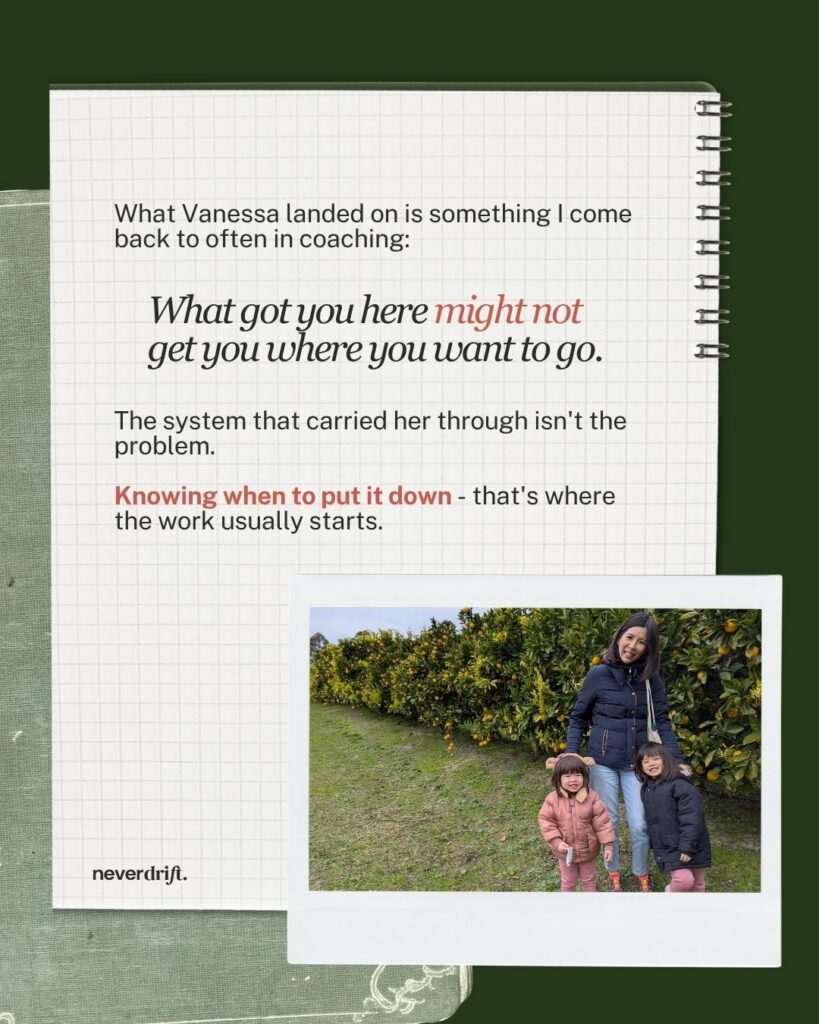
What Vanessa arrived at is something I come back to often in coaching with high-achieving clients: What got you here might not get you where you want to go.
The systems we build to cope – the spreadsheets, the over-preparation, the self-reliance, the not showing weakness – they work. They carried Vanessa through a COVID relocation, 2 pregnancies, a demanding career and the restructuring of her entire home life without help.
The more pertinent question now is whether it’s time to evolve the system. Whether she has enough self-knowledge to choose when to use it and when to put it down.
That’s what coaching made available to her: The self-knowledge to operate her existing system with more intention and more grace toward herself when the system runs hard.
If you’re someone who functions very well under pressure and has started to notice that the pressure never quite switches off, that might be worth looking at.
The system that carried you through isn’t the problem. Knowing when to put it down and evolve your current operating system – that’s where the work usually starts.
Not sure where your drift is showing up? The Drift Finder is a good place to start. It’s a free self-assessment for high-functioning individuals who sense something is off but haven’t quite named it yet. Link here.


Be The First To Comment