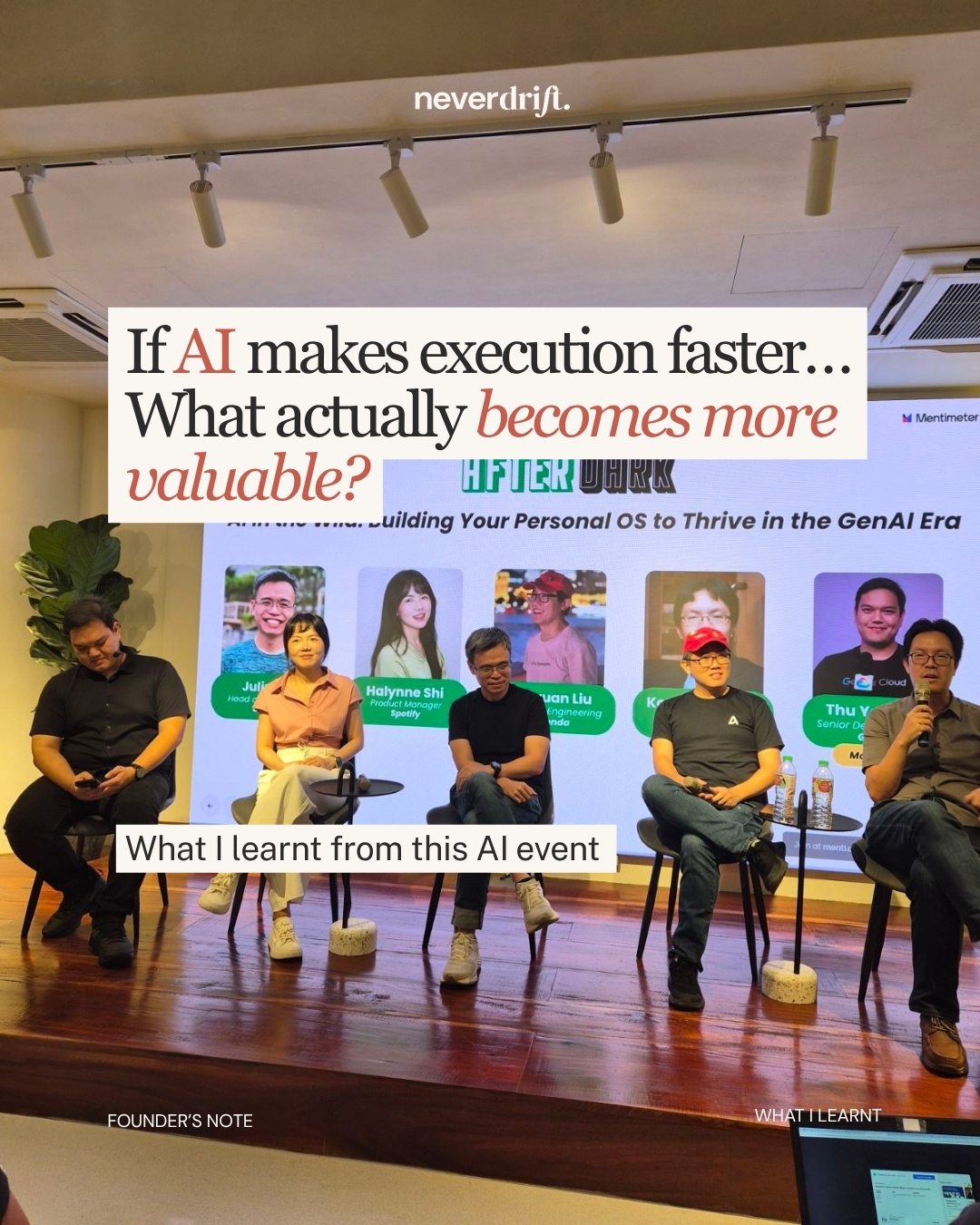
I attended an AI learning event last week and as I reflected on the discussions, this question was the top one that surfaced for me:
If AI increasingly makes execution faster and easier, what actually becomes more valuable?
Right now, there is a collective anxiety around AI.
A constant pressure to keep up. Try the latest software. Learn the newest workflow. Figure out how not to become irrelevant.
We definitely should learn this – but one thing the panel articulated really well was this:
AI is still a tool.
Learning the tools matters. But the people who thrive won’t simply be the ones who know or uses the most tools.
They’ll be the ones who refine how they think, decide and adapt.
Key Takeaway 1: What truly matters?
When generation of knowledge becomes instant, execution is no longer the bottleneck.
The bottleneck returns to human capability. I like this 5C framework that was shared during the panel discussion:
- Curiosity: The drive to ask sharper, deeper questions.
- Curation: The ability to distill meaningful signal from overwhelming noise.
- Communication: The capacity to articulate ideas with clarity and intent.
- Critical Thinking: The discernment to know when an output sounds convincing but lacks substance.
- Common Sense: The grounded judgment that software can’t replicate.
This shift also changes the ratio of our work changes. Planning and review start to heavily outweigh execution itself.
If AI helps us do things 10x faster, the most strategic question we can ask is more of “Is this actually worth doing?”
Key Takeaway 2: What are we amplifying?
My other big learning from the evening was that AI is an amplifier which raises a more important question – an amplifier of what?
It can amplify your expertise, creativity, and judgment.
But if you aren’t careful, it will just as quickly amplify your confusion, your avoidance, and your tendency to stay context-switching busy without ever actually taking a tangible step forward.
A key part of adapting in this era is itself an exercise in self-awareness.
It requires knowing your baseline strengths, identifying where you need support, and deciding which parts of your thinking you want AI to amplify rather than outsource entirely.
Key Takeaway 3: How do we anchor ourselves?
This may have been the biggest takeaway for me.
Technology can accelerate our pace. But it still can’t decide our destination.
As the landscape continues to shift beneath our feet, I don’t think the answer is to drift passively with the tides nor is it to run frantically after every shiny new tool.
It’s to stay curious (the first C) – Keep learning, adapting and above all, remain intentional about the direction you’re moving in.
Moving faster means very little if you’re heading the wrong way.
If something in this post made you pause, that’s usually worth looking at. Learn more about working with Natalie here.