
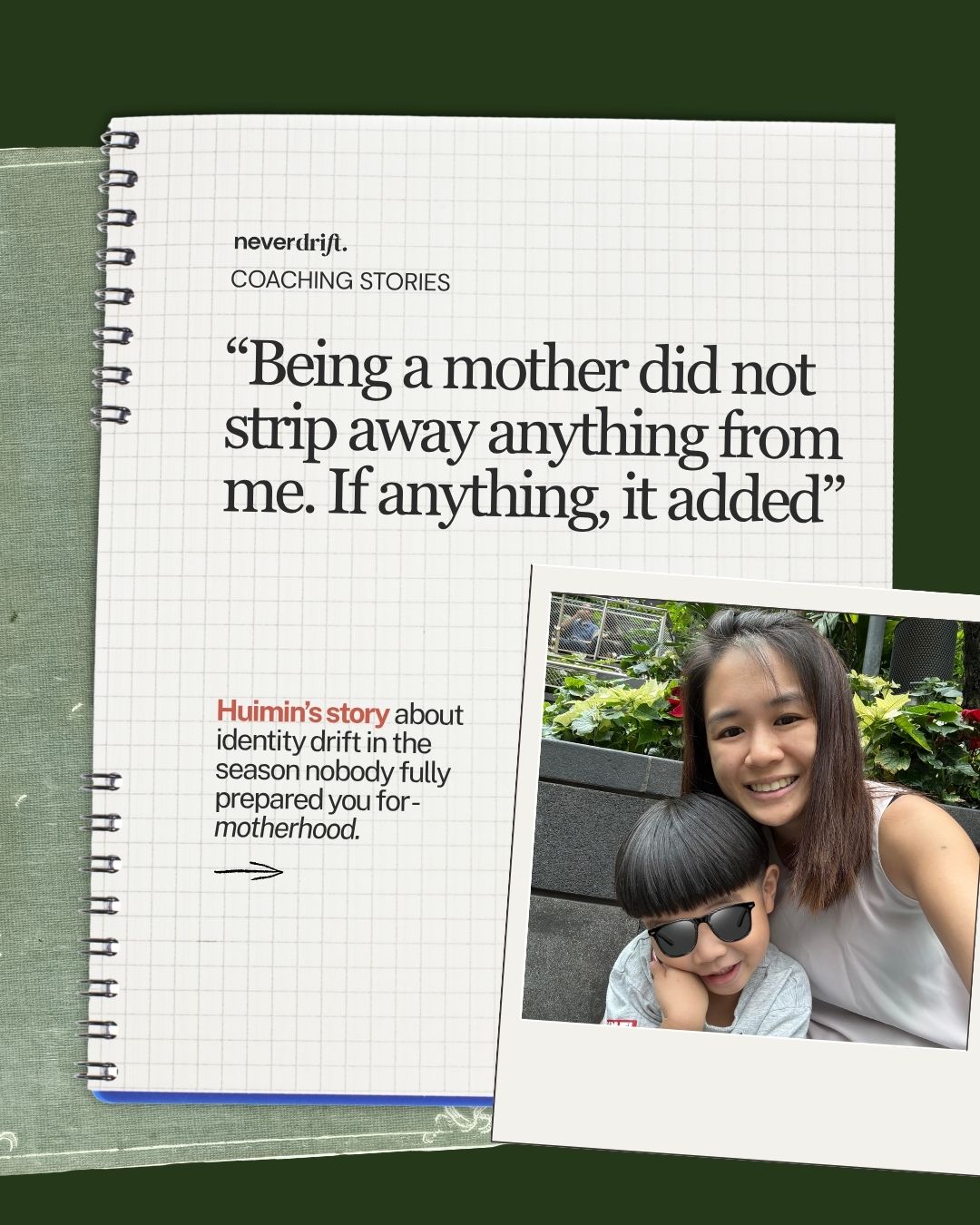
Huimin and I started coaching work together at a point when she was several years into motherhood, 2 children in and had more distance to look back at the early years clearly.
That distance matters in the context of her story.
She wasn’t in the middle of the newborn fog or navigating the rawness of a first year. She had come through it and what she could articulate from the other side – with clarity, with humour, with the kind of perspective that only time gives you – is something I really appreciate her sharing with us.
Her story is less about survival and more about what you understand once the dust settles.
What you can finally see when you’ve had time to look back at who you were in that season and see it whole.
Huimin, in her own words
“The newborn phase was brutal, mostly due to the lack of sleep and having to adjust your schedule to fit a tiny human who could only express his needs by crying. We couldn’t go out much, struggled with cooking and eating well, worried too much about anything and everything. It was survival mode for about six months. I lived day to day, doing what was necessary. The amazing thing about motherhood is that you have no time, so you cut all the nonsense out of your life.
When I went back to work after my maternity leave, everything felt off. I went from five months of being concerned about sleep, poop and milk, to management meetings and one-on-ones with staff. The brain took a while to warm up. I also felt torn between being a mother and being a worker – I enjoyed the intellectual rigour of my job very much but the thought of only spending one to two hours with my child after work every day was painful. I also didn’t know who I was, whether this mum guilt would ever go away, and whether I was doing the right thing. I was worrying all the time.
I was quite lonely as well, though my days were filled with activities. With young children, you don’t really go out at night or on weekends. At work, I was busy with work. When I came home, I was busy with my kid. After my kid slept, I was busy with household chores and getting ready for the next day, and also trying my best to reconnect with my husband. Community looked different than what I was used to. The friends that stayed are the friends who love me, together with the new-found addition to my family.
After two children, I have come to think that motherhood is something that forms part of my new identity, and that I shouldn’t separate motherhood from the rest of me. There is no them without me, and I won’t be the new version of myself without them. I also had this realisation that every role that I play concurrently makes me who I am, in totality. Embracing that I am in a new season, with different priorities and demands helped greatly. This season is precious to me – I get to be a mum to two young children who think I am their world, my parents are still active and still around, I have my health and I am in a season where I am building my career, with a husband who is fully supportive of what I do. I may not be travelling the world, but I have blessings that money is not able to buy.
Being a mum gave me courage to do things I never thought I’d do. I stepped away from a management position and went into self-employment for my children. Parenting my kids also gave me a chance to re-parent myself, to have the strength to break patterns and mindsets, because I want to be better every day for my children.
Being a mother did not strip away anything from me or my identity. If anything, it added and poured into me in indescribable and unquantifiable measures of who I feel I was meant to be.
What I’d say to women earlier in the journey: sleep works wonders, talk to fellow mums, be present, everything’s going to be okay – and you’ll find yourself again.”
What the loneliness is actually pointing at
There’s something Huimin shared that I want to highlight because I think it goes under-acknowledged in conversations about motherhood and identity.
She describes being busy AND lonely at the same time.
That combination is important. It’s not loneliness from having nothing to do or nowhere to be. It’s the loneliness that comes when the version of yourself that used to connect with people – through work, through friendships, through the easy rhythms of life before children – is suddenly operating on a very different schedule and in a very different world.
The people who stayed, she says, are the ones who love her. The ones who made it through the restructuring of her whole life.
What I see in sessions, especially with high-achieving women in the early years of motherhood, is that the loneliness is often less about the relationships and more about the loss of the version of themselves they used to show up as in those relationships.
When your days are structured around another person’s needs, the parts of you that used to feel most like you – the capable, self-directed, intellectually engaged parts – go quiet for a while.
Sometimes such a long while till you stopped feeling like yourself.
The identity question underneath the guilt
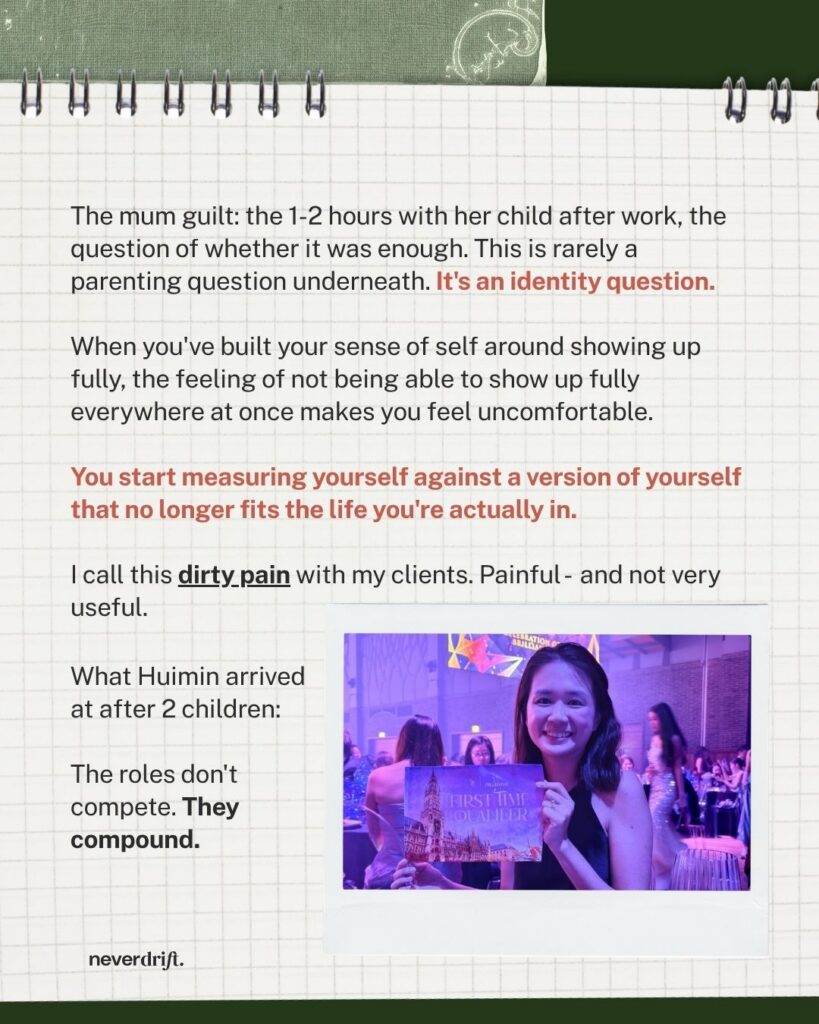
Huimin describes carrying mum guilt – the specific weight of spending one to two hours with her child after work and wondering whether it was enough, whether she was doing the right thing.
What’s underneath that guilt, most of the time, isn’t a parenting question. It’s actually more of an identity question.
When you have built your sense of self around being someone who shows up fully – in your career, in your relationships, in all the ways that mattered before – the feeling of not being able to show up fully everywhere at once makes you feel uncomfortable.
You start measuring yourself against a version of yourself that no longer fits the life you’re actually in.
The audit is painful. It’s also not very useful. I call this dirty pain with my clients – the suffering that comes not from the situation itself but from the story we layer on top of it. The incessant measuring and comparing, together with a sense of failing at something that was never actually the standard to begin with.
What Huimin arrived at, after 2 children and the perspective that comes with time, is something I see as one of the most important realisations available in this season: the roles don’t compete with each other. Every role she plays concurrently makes her who she is, in totality. There is no separation to maintain. It is more of an integration of the different roles she plays.
That’s a meaningful shift – from managing the tension between identities to understanding that the tension itself is the signal.
What motherhood gave her
What Huimin describes at the end of her reflection – being a mother gave her courage to do things she never thought she’d do, stepping away from a management role, breaking patterns for her children, re-parenting herself – this is what I mean when I talk about threshold seasons.
Not all seasons ask the same thing of us.
Some ask us to hold steady while others ask us to adapt and let the process shape us into a version we couldn’t have built any other way.
She stepped away from a management position and went into self-employment.
She built something new in the season and she came out of it more herself than when she went in.
A closing thought
Huimin’s story is a reminder that integration isn’t something you achieve in the hardest moments. It’s something you recognise, often only in hindsight, once you’ve come through.
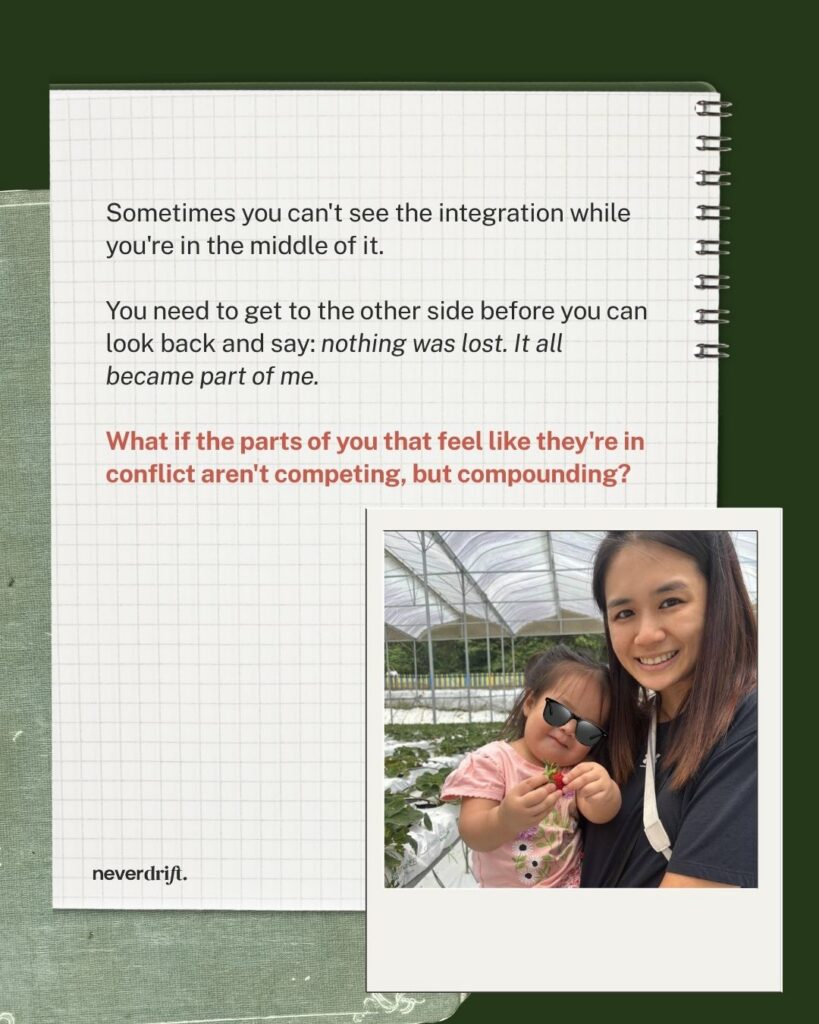
Sometimes you can’t see the compounding while you’re in the middle of it.
You need to get to the other side before you can look back and say: Nothing was lost. It all became part of me.
I am honestly so proud and honored to have witnessed how much Huimin has grown in this journey as we reclaimed and strengthened parts of herself.
The question worth sitting with, wherever you are in this: What if the parts of you that feel like they are not actually competing, but compounding?


Be The First To Comment