
I first met Shin when she was trying to figure out how to hold her ambition and her identity as a mother at the same time, as if the two were in competition and she had to choose.
She came in the way many high-functioning women do: clear on what she had achieved, less clear on who she was becoming.
The version of herself she kept measuring against didn’t have a baby, didn’t need rest, and didn’t feel like she needed that much help. That version was still very much running the show, which made complete sense because that’s who she had been for most of her life.
What she didn’t yet know was that the work she had done on herself before motherhood arrived would be what carried her through it.
This is Shin’s story. In many ways it’s about the most difficult thing the motherhood asks of driven women: not just to adapt, but to grieve the old life and build something new.
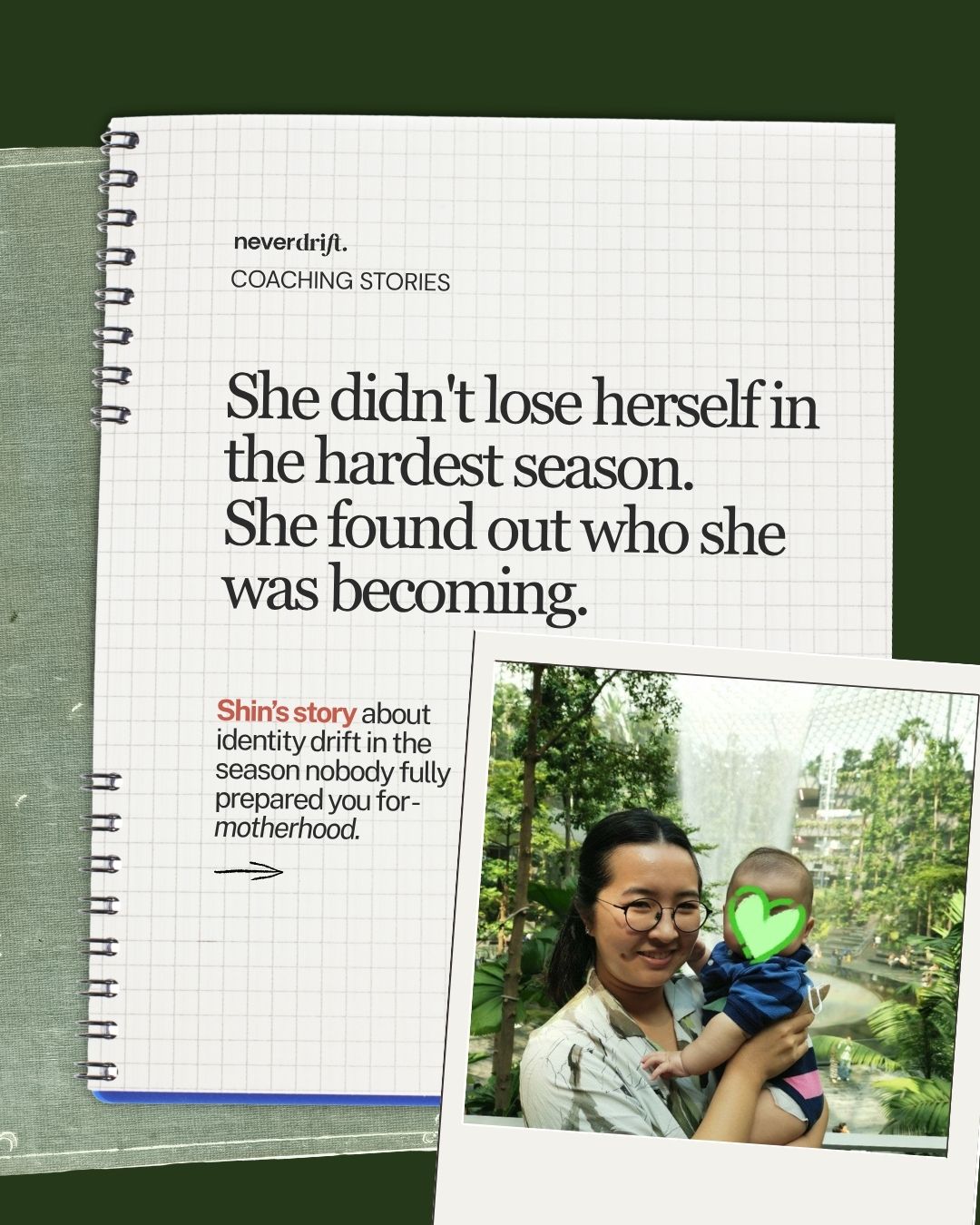
Shin, in her own words
“When I found out I was pregnant, I felt almost invincible. I was doing well in my career, I had a lot of interesting projects, and I was feeling strongest from all the powerlifting, Barry’s and yoga that I did. I thought I could power through motherhood like how I always powered through adversities earlier on in my life – sacrifice sleep, stick to my plan, and work harder.
Falling really sick during my pregnancy was the first time I felt that my mind and body had distanced themselves. I could no longer will myself back to the pink of health. I could not even sit up without help or support after my surgery, let alone walk for extended periods of time without panting. I had envisioned myself to continue to live my life as I always had in my mid-twenties into my late-twenties as a young, cool and active mum.
The real work and recovery could only come after I gave birth – and once again, reality had hit me hard, again. Child-bearing and child-birth was no walk in the park, and I underestimated how my past surgeries took a toll on my pregnant body. I tried willing myself to go back to my old life, leading an active life, packed social life, and going above and beyond at work.
The burnout during the first year of motherhood was the worst I had ever felt. I realised I could no longer continue the way things were, or how I thought things should always have been. I had to remind myself that that was my old life. I had to say goodbye to it.
Building a new way of life was difficult. There were times when I grieved for my old life. But during those happy moments when I was there for my child, I realised none of the things I held important in my early-to-mid twenties mattered anymore.
It didn’t matter that my life did not pan out how my vision board looked, or that I did not stick to my 10-year plan. Watching my kid discovering the world, asking questions about how things work, even the simplest most mundane questions, made me realise that as adults we had lost our sense of wonder over time.
I started to wonder what this new phase of life would look like. And he inspired me to be curious again, not only about my own next phase of life but into the lives of others.
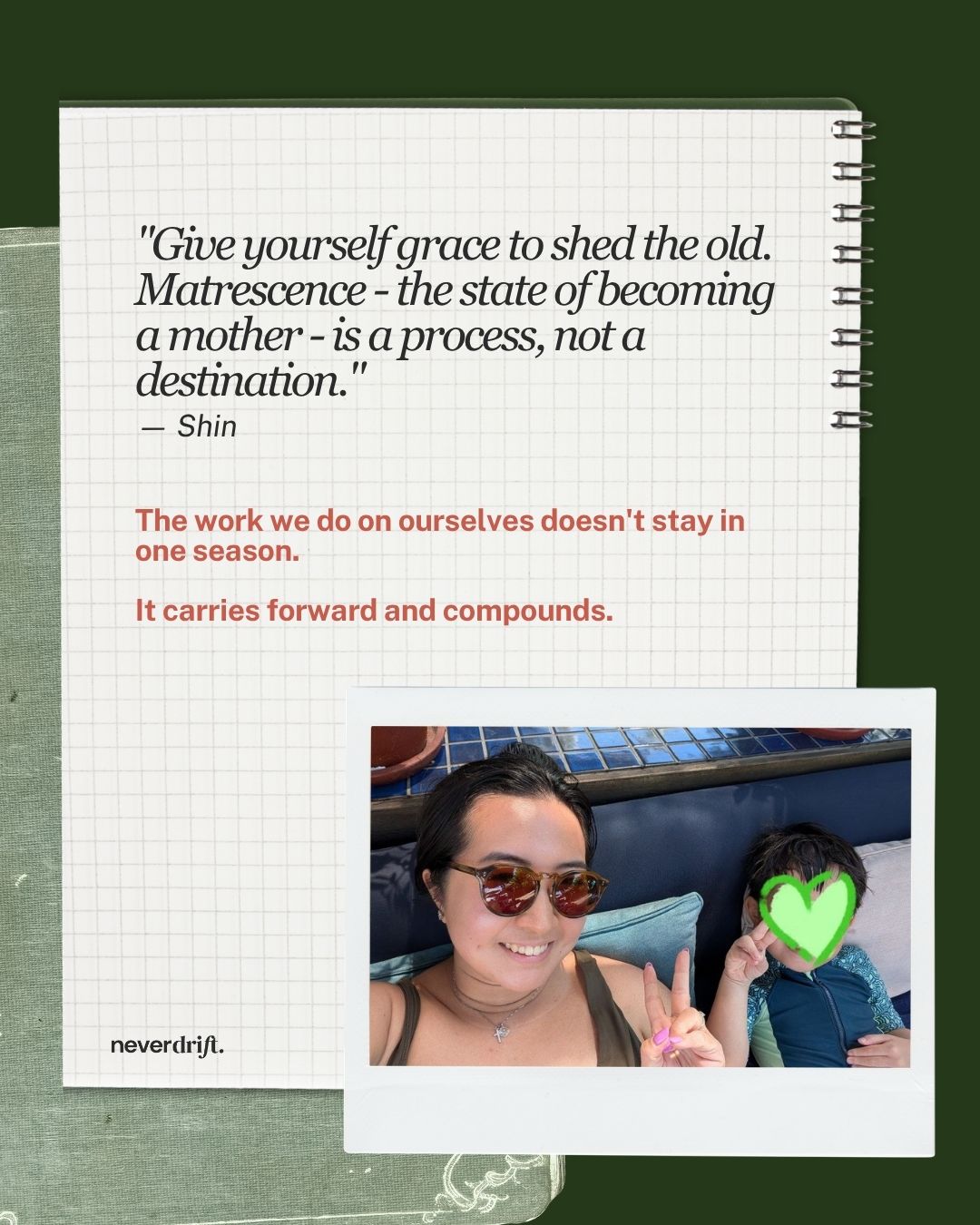
For first-time mothers, especially those who are still in the throes of the newborn stage: you’re not alone. Let your child teach you and guide you on this new identity and give yourself grace to shed the old. Matrescence, the state of becoming a mother, is a process and a journey, not a destination upon your child’s birth.”
What Identity Drift looks like when it pretends to be drive
There’s a pattern I see consistently in high-functioning women, and Shin’s experience names it precisely.
She told me once that she felt like she had to work even harder because she was pregnant, in case anyone thought the pregnancy was an excuse for her to not be working so hard. I’ve heard this from other women too. It looks like drive but it is actually Identity Drift playing a very convincing role.
The version of herself Shin kept measuring against was the active, ambitious, always-delivering woman in her mid-twenties, and that version was still the operating template. Motherhood didn’t update it. She was trying to live inside a template that no longer fit, and the gap between who she was becoming and who she thought she should still be was creating enormous internal pressure.
This is what Identity Drift looks like in a threshold season when something major in your life happens.
The burnout Shin describes in the first year of motherhood wasn’t a failure of discipline or resilience. It was what happens when the identity question stays unexamined long enough: you keep performing the old version of yourself until the body says no.
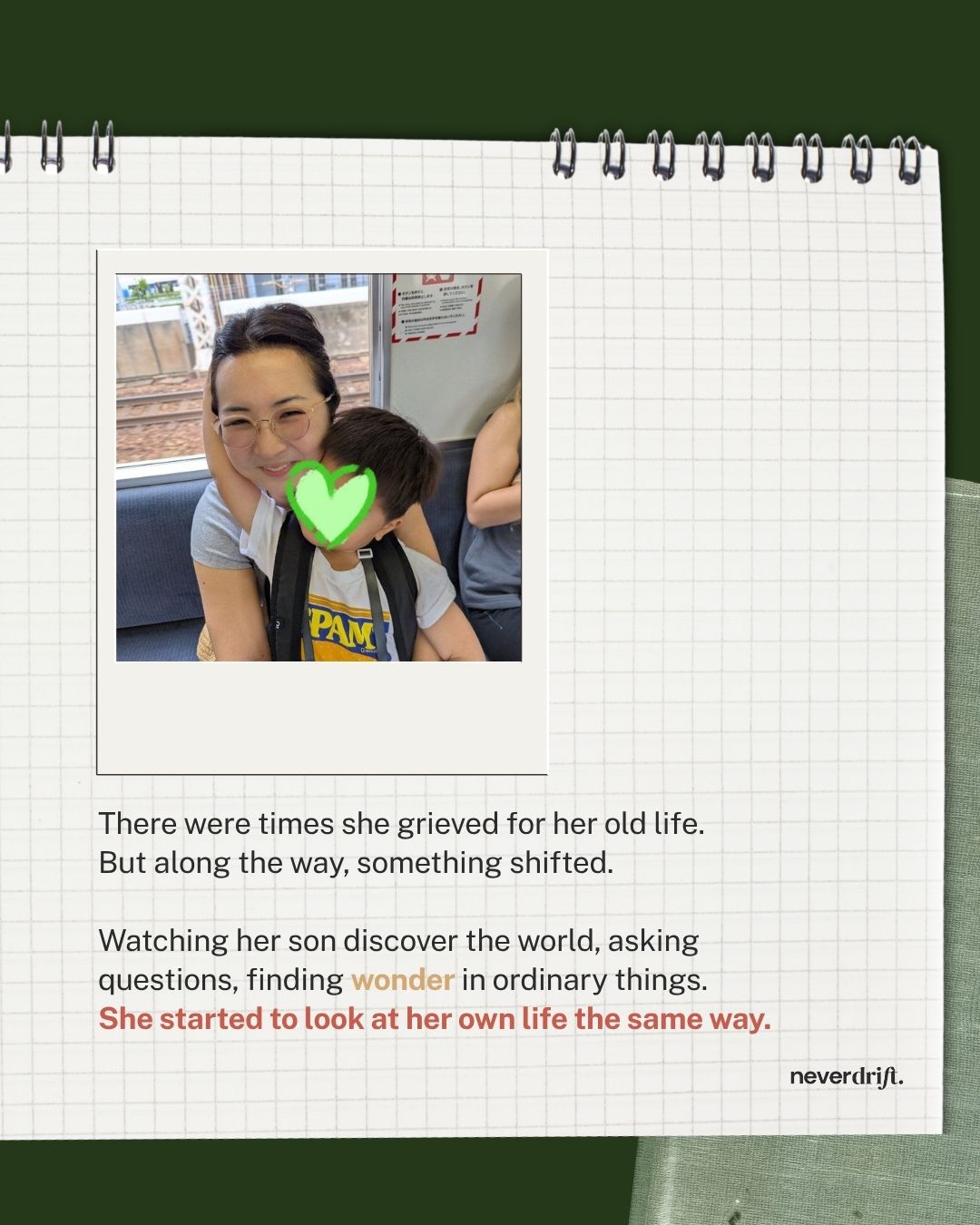
Two things can be true at once
What we kept coming back to across the work was this: two things can be true at once. You can be ambitious and be a present mother. The tension she was feeling wasn’t a problem to solve. It was an identity to get clear on and build.
Once she got clearer on that, the day-to-day became less of a fight. She wasn’t constantly toggling between two versions of herself or measuring the new life against the old one and finding it lacking. She was building something different, something that held both.
When she found out she was pregnant again, something was different. She realised that the things she had learned the first time around were actually available to her. That’s exactly what the work is for: not just surviving a hard chapter, but integrating it so the next one doesn’t start from zero.
What her son taught her
Something Shin said about her son has stayed with me, that children carry a sense of wonder that most adults have let go of somewhere along the way.
Watching her kid discover the world, asking questions about how things work, approaching the ordinary with genuine curiosity, she found herself looking at her own life through that same lens. We start to see ourselves not as something fixed, a version that either succeeds or fails against a predetermined standard, but as something still unfolding. Curious about who we’re becoming. Willing to let the next season teach us something the last one couldn’t.
That’s the reminder I take from watching Shin move through this. The work we do on ourselves doesn’t stay in one season. It carries forward and compounds. Somewhere down the line, when we meet the next challenge, it shows.
A closing thought
Shin’s story is not about coaching making the hard season easier. The burnout was real. The grief for the old life was real. The physical recovery was hard in ways she hadn’t prepared for.
What the work made possible was that she didn’t lose herself inside it. She had language for what was happening, a framework for the identity question underneath the exhaustion, and when the next season arrived, she didn’t start from zero.
If you’re in a season that’s asking you to let something go, a version of yourself, a plan that no longer fits, an identity that served you before but is costing you now, that’s not a failure. It’s a signal. Usually it’s pointing at something worth paying attention to, and that’s where the work begins. 🍃
Note: Not sure where your drift is showing up? The Drift Finder is a good place to start. It is a free self-assessment for high functioning individuals who sense something is off, but haven’t quite named it yet.


Be The First To Comment