“I always have to do things right. If I were actually smart enough, I’d already know how to handle this.”
If that internal dialogue sounds familiar, you aren’t alone.
Many high-functioning professionals spend an exhausting amount of energy managing outcomes: the exact quality of a deliverable, the tone of a Slack message, or the outcome of a key project.
It hangs over your head throughout the day, bleeds into your weekends, keeps you from being present with the people you love, and also wrecks your sleep quality.
On the surface, this looks like conscientiousness. It looks like having high standards, being reliable, and caring deeply about your work.
But what I learnt and want to highlight – it is often hyper-vigilance – a protective mechanism designed to keep you safe from criticism, failure or exposure.

The Trap of Built-In Worth: Why Reassurance Doesn’t Work
For people who built their sense of self-worth through performance, by being the one who gets it right, figures it out, and never needs help, it can actually be pretty agonizing to sit with uncertainty.
When your worth depends on being flawless, any unexpected variable feels like a existential threat.
In careers, this manifests as:
- Answering emails on Saturday morning “just in case” a slow reply costs you an opportunity or client.
- Constant internal auditing, bracing, and over-preparing that slips into burnout.
- Struggling to delegate because you can’t control how the output reflects on you.
Why Logic and Reassurance Fail
You might think that receiving praise or successfully delivering a project would quiet the anxiety.
It doesn’t.
You know this as the wave of anxiety comes back.
Why?
Our nervous system has been conditioned through our past experiences that success does not mean safety; it registers success as proof that your hyper-vigilance is working.
It thinks, “We survived BECAUSE we stayed on high alert HENCE we have to keep doing it.”
This keeps your body in a chronic state of “unsafe,” – always waiting for the other shoe to drop:
“What if I’m not actually as good as they think? What if it was all just a fluke?”
From “Board of Directors” to Executive Leadership
To break this loop, we have to work with the different parts of our mind.
Drawing from the principles of Internal Family Systems (IFS), I like to view our internal landscape as a corporate board:
- The Board of Directors: The various reactive parts of us (the anxious protector, the perfectionist, the inner critic). Each part has its own narrative, fear, and outdated way of keeping us safe.
- The CEO (Your Ideal Self): The grounded, intentional, wise leader within you who can navigate complexity with clarity rather than fear.
A Real Client Breakthrough
Recently, a client sent me a message on a Saturday morning.
Her nervous system had flagged a minor work situation as a major crisis, triggering her default playbook: overwork, fix it immediately, and panic.

I wanted to explore with her why her nervous system registered this as a threat:
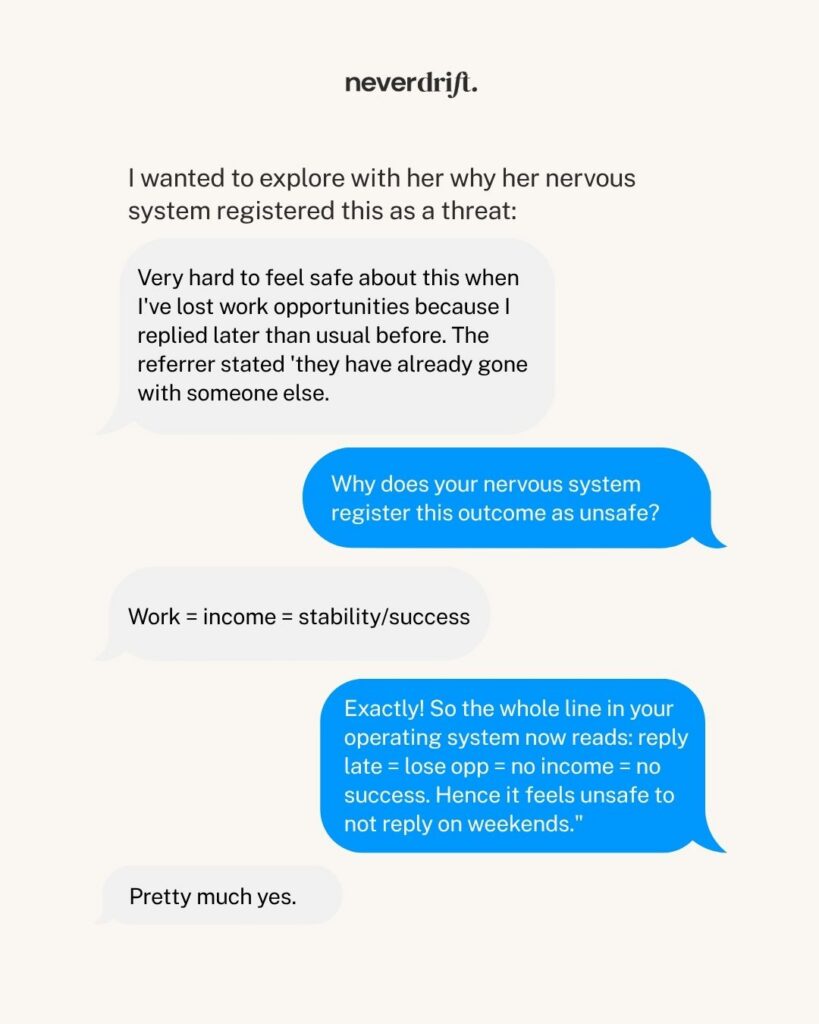
In our sessions, we had already identified her “Board of Directors.”
Instead of letting her anxious inner critic run the company, I asked her:
“What happens if you invite your CEO into the room right now? What alternative playbook would she run?”
By stepping into her CEO state, she immediately shifted her perspective:
- The Anxiety Eased: Simply changing who was steering the ship gave her nervous system room to breathe.
- Space for Facts over Fear: With her threat response quieted, she could evaluate past evidence and objective facts instead of reacting to catastrophe narratives.
- Different Action: She chose an intentional, calm response rather than a panicked, reactive response that would derail her Saturday.


Rewiring Your Neural Pathways Is Possible
I’ve watched smart, capable leaders carry the burden of hyper-vigilance for years (and it’s a pattern I’ve had to untangle within myself as well).
Fortunately, I also learnt that we do not have to live in a state of constant internal bracing.
With neuroplasticity, within months, it is entirely possible to rewire these neural pathways so that the exact same Saturday-morning trigger produces a completely different, peaceful response that is more aligned with the life you want to lead.
Question for Reflection: Where in your life are you mistaking hyper-vigilance for conscientiousness? What would your inner CEO do differently today?
Ready to Update Your Playbook?
If you recognize yourself in this cycle and you’re tired of mistaking hyper-vigilance for high standards, we can untangle the patterns keeping you stuck.
A Drift Map Session is designed to map out the exact “Board of Directors” running your default responses, help you identify where safety has been outsourced, and build the playbook for your inner CEO.