That’s the thing nobody tells you about drift – it doesn’t feel like losing your way. It feels like a very full, very productive, completely reasonable life.
1. How It Started
During my consulting and Google years, I had all the markers of someone who had figured it out. The career was moving. The work was getting recognized. From the outside, and honestly from the inside too, it looked like progress.
But there was this quiet thing underneath all of it that I couldn’t quite name. A kind of flatness where feeling used to be. I’d finish a project that six months earlier I would have been proud of, and I’d feel… fine. Competent, ready for the next one but not actually moved by any of it.
I was performing well and feeling nothing and I was doing it well enough that nobody flagged it as a problem, including me.
What I understand now is that this is where drift almost always begins – not in the circumstances of your life but in your relationship with yourself.
Somewhere along the way, without a single deliberate decision, I had stopped becoming the person I intended to be and started becoming the person the role required.
The goals I was hitting weren’t really mine anymore. The version of success I was building toward had been shaped more by what was expected and rewarded than by anything I had actually chosen. I just hadn’t noticed, because the results were still good, and high achievers are trained to use results as feedback.
If the scoreboard looks fine, you tell yourself you must be on the right path.
The busyness made it easier not to look. My days were completely full – client work, late nights, weekends that bled into the week. It is easy to mistake that fullness for purpose.
It took a long time for me to realise that I was using the pace of my life to avoid a question I didn’t know how to answer. What am I actually building here? Not in terms of the next promotion or the next project. But in terms of a life. What is this all for?
I had never stopped long enough to ask. So I kept moving, which felt responsible and disciplined and like exactly what you’re supposed to do while underneath the busywork, my sense of where I was actually going had quietly disappeared.
The things that were actually me kept getting moved to later. The parts of my life that had nothing to do with performance and everything to do with who I actually was. Later became a very long time. By the time I noticed the distance (in my relationships, in my habits, in the way I showed up for the people I loved), it had been accumulating for years.
The clearest signal, the one I genuinely couldn’t explain away, was my body. I gained a significant amount of weight. My eczema flared badly. My skin broke out. I was exhausted in a way that sleep didn’t really seem to help with.
I kept attributing it to stress, to the season, to needing a holiday. But what was actually happening was that everything I hadn’t processed. The dissatisfaction, the misalignment, the emotions I’d been too busy to feel had now found somewhere else to live. That’s what it looks like when something sits unaddressed long enough. It stops being merely a feeling and starts being a body keeping score.
The people around me were getting whatever was left after all of that which wasn’t much to be honest. I was physically present in most of the relationships that mattered to me and genuinely absent from nearly all of them.
It was not because I didn’t care but because I was running on a version of myself that had been so compressed by the pace and the performance and the not-stopping-to-ask that there wasn’t much of me left to actually show up with.
None of this felt like a crisis. Every single part of it had a reasonable explanation. This is just what this season looks like. I’ll recalibrate when things settle. It won’t always be like this.
That’s how drift works. It doesn’t arrive as an emergency. It accumulates in the gaps between the reasonable explanations, quietly moving through one area of your life and then the next, until one day you surface and ask yourself the question I finally asked.
Is this the life I worked so hard for?
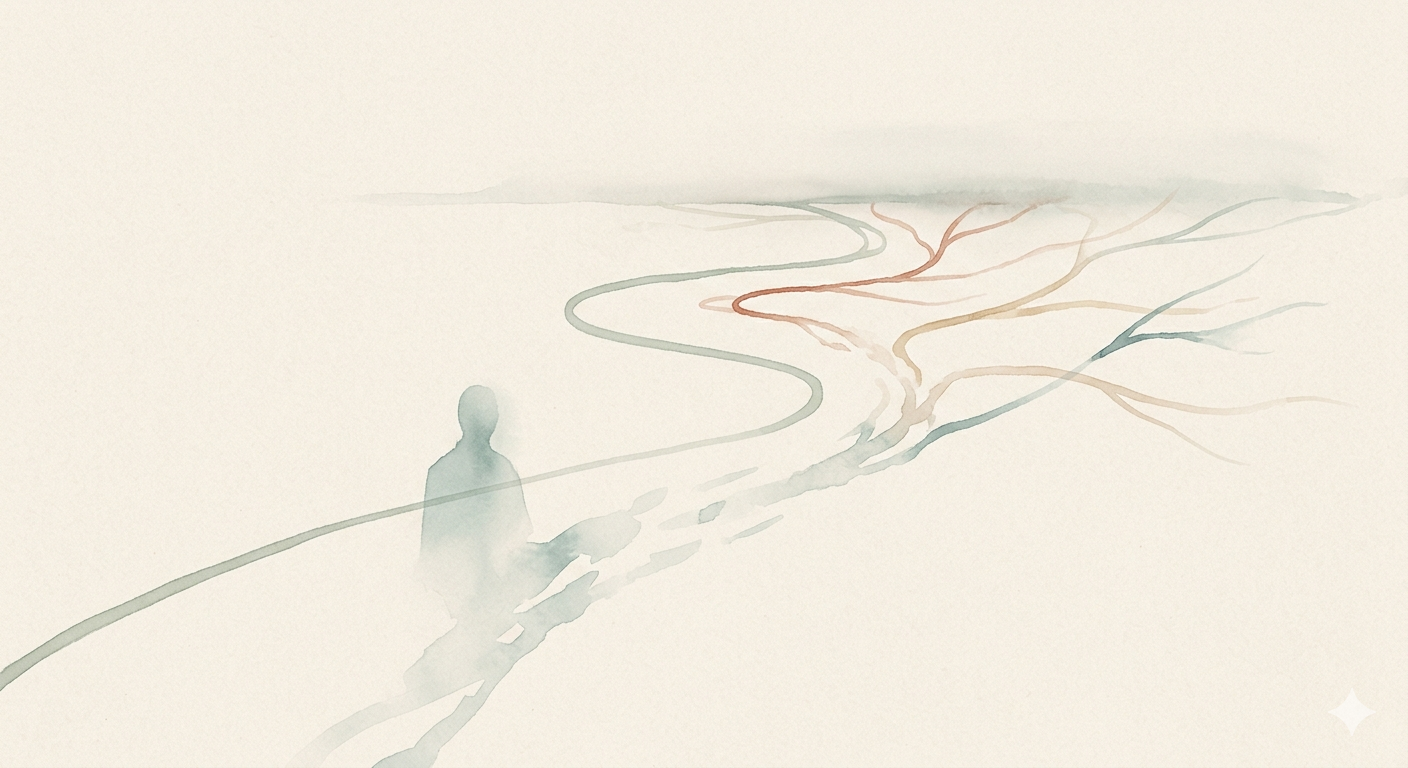
2. What It Looks Like
When I started working with clients through Neverdrift, I kept encountering the same story in different shapes.
Intelligent, capable, self-aware people who had built lives that looked right from the outside while something essential had been quietly shifting inside them. People who knew something was off but couldn’t locate it precisely enough to do anything about it. People who were, without realising it, living at increasing distance from themselves.
What I’ve come to understand is that this distance isn’t random. Drift moves in a sequence.
- Identity: It tends to start in how you see yourself – in the gap between who you’re becoming and who you intended to be.
- Emotional: From there it moves inward, into your emotional life, until the feelings that used to orient you also start going quiet because you have been ignoring them.
- Directional: When your internal compass dulls, your sense of direction follows – the clarity about what you’re building and why starts to blur at the edges.
- Behavioral: When you’re no longer sure where you’re going, your daily habits quietly shift from momentum to maintenance, from building toward something to just holding the current state together.
- Relationships: By the time it reaches your relationships, the drift has usually been moving for a while. The people closest to you start to receive a curated, compressed, slightly absent version of who you are. The distance in those relationships – which often feels like the most painful part, is really just the last place the drift landed.
I see this sequence in almost every client I work with. But more importantly, I lived it so completely that I now recognise the early stages in a way I couldn’t when I was inside them.
The reason it goes unaddressed for so long is not that the people experiencing it are unaware or unsophisticated. It’s that drift doesn’t look like a problem. It looks like a busy season. It looks like discipline and responsibility and just getting on with it.
The same qualities that make high achievers successful (the resilience, the ability to push through, the capacity to perform under pressure) are exactly the qualities that make it possible to keep going for years while the drift compounds underneath.
Every layer it passes through is time. Time spent becoming someone slightly less yours, making decisions from a version of yourself that’s been shaped more by momentum and avoidance than by anything you consciously chose.
The hardest cost of that all is the slow accumulation of a life that looks fine while something essential inside it has been quietly slipping.
By the time most people notice it, they’re at layer four or five. There’s a lot of ground to cover back.
The question worth sitting with isn’t whether you’ve drifted. It’s where it started — and what it’s already cost you.
The good news: you’re asking now. 🍃
3. If this landed somewhere close
The five diagnostic questions I return to are simple. They’re worth sitting with one at a time, not all at once.
- Identity: Am I still becoming the person I once intended to be?
- Emotional: Are my emotional states steering my life more than my intentions?
- Directional: Am I moving with intention, or just staying occupied?
- Behavioral: Do my habits reflect the life I say I want?
- Relationships: Am I genuinely present in the relationships that matter most to me, or am I maintaining them from a distance?
You don’t need to answer all five. Just notice which one you’re most reluctant to look at. That’s usually where the drift is deepest.
🍀If something in this post made you pause, that’s usually worth looking at. Learn more about working with Natalie here.