
This month, a theme kept surfacing in my own inner world, and in the conversations I was having with clients. I’ve been calling it emotional drift.
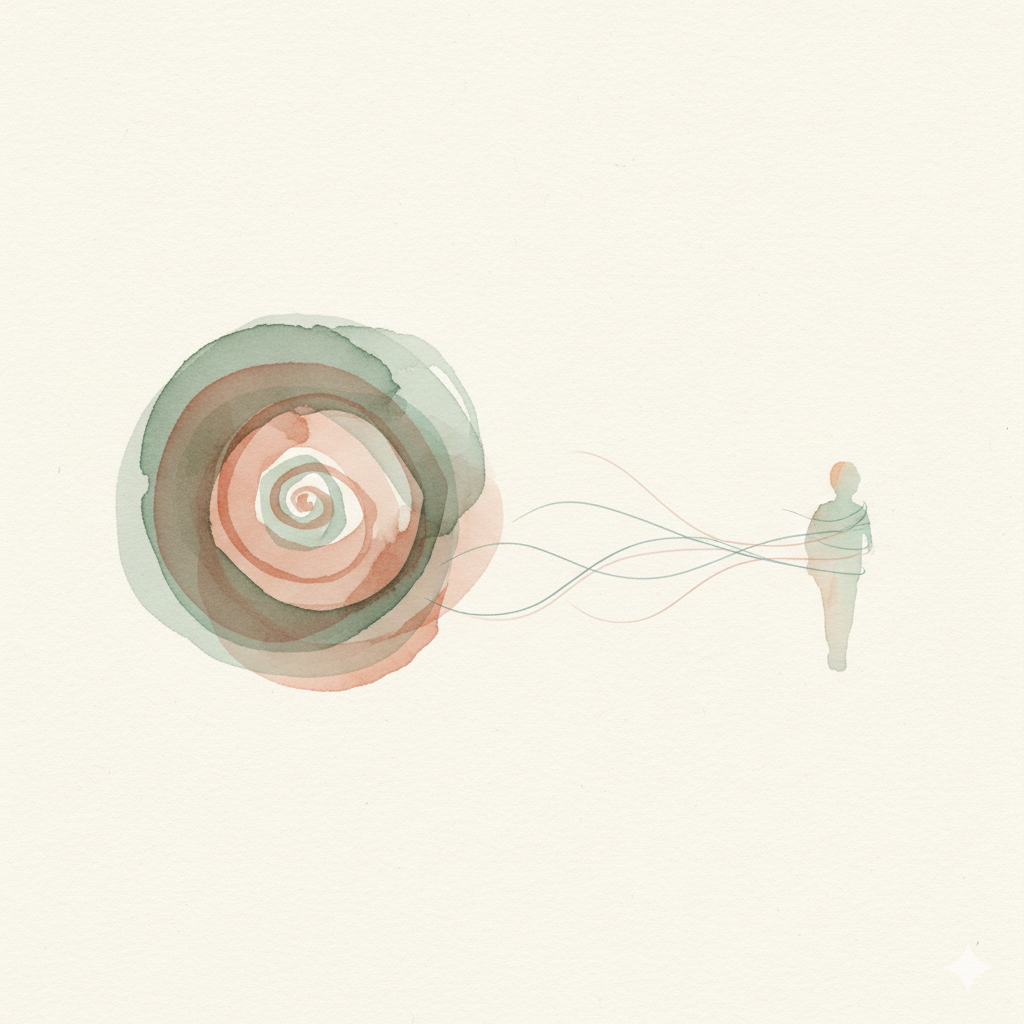
It’s that quiet pull that happens when thoughts start running the show.
One thought leads to another, and before you know it, you’re deep in a spiral – analyzing, replaying, projecting.
You’re no longer in the present. You’ve drifted.
What I’ve come to understand in my own journey is that thoughts don’t appear out of nowhere. They come from our past experiences, the stories we absorbed, the conclusions we drew about ourselves and the world.
Over time, these become beliefs. And the thing about beliefs is that most of us have never paused to question them. We never asked: Is this still true? Is this something I want driving my life?
But whether we examine them or not, they drive us anyway.
And when we let those thoughts run unchecked, our emotions get stirred. That internal state then influences how we act, what we say, what we create and ultimately, the reality we experience.
I watched this play out again and again this month:
- Someone obsessively checking for a job offer.
- Another person replaying every detail of a business miss, trying to logic their way to a different outcome.
- Someone else analysing a romantic situation as the uncertainty felt unbearable.
The circumstances were different, but the pattern was the same: the mind reaching for control over something that hasn’t happened yet or can’t be changed.
Because that is the only way it seems that it is exerting some kind of control.
However it doesn’t just exhaust us. It keeps us in pain much longer than necessary.
This also reminds me of the parable of the first arrow and the second arrow. The first arrow is what happens to us. The second arrow is what we do to ourselves in response – the ruminating, the self-blame, the relentless why, the compulsion to still create a different outcome.
The first arrow may be unavoidable. The second one, we often choose, without realising it. I also call this clean pain vs dirty pain.
Emotional drift is living under the weight of that second arrow (dirty pain).
This also reminds me of why I do the work that I do: on myself as I continue receiving coaching and also helping people to strengthen self leadership.
To me, self leadership isn’t just about managing your external actions or hitting your goals. It’s about building an anchor internally.
It’s the capacity to notice when we have drifted from our values, from the current moment, from ourselves and to anchor ourselves again. Not through force, but through awareness and intention.
We can’t always control what thoughts arise. But we can learn to lead from a place that’s deeper than them.
That’s the on-going work and I think it’s some of the most important work there is.


Be The First To Comment